What Can You Actually See At The Beijing Ancient Observatory?
A honest look at the Beijing Ancient Observatory: the bronze instruments on the terrace, the exhibition halls, the garden, the CNY 20 door price, the 5-day reservation window, and the Tuesday closure.
What Can You Actually See At The Beijing Ancient Observatory?
What you can see is a walled compound in Dongcheng with three things: a rooftop terrace lined with antique bronze astronomical instruments, a garden below them holding historic timekeeping devices, and small exhibition halls covering the history of Chinese astronomy. Entry costs CNY 20, a reservation is mandatory, the booking window opens 5 days ahead, and the whole visit is compact rather than sprawling.
The observatory sits near Jianguomen in Dongcheng, a short walk from the intersection of the Second Ring Road and Jianguomenwai Street. It is easy to miss, which is part of its character. The compound is a raised brick platform with a building on top, and the platform is the point. This is not a museum that happened to be built around a collection. The site itself is the artifact: an imperial astronomical station where court astronomers watched the sky, kept the calendar, and reported what they saw to the throne.
What surprises most first-time visitors is the scale. Expecting something on the order of the National Museum of China, they find a compact site that a slow visit covers comfortably. The terrace instruments are the headline. Below them, a garden holds additional devices. Inside the halls, displays explain the site's working past. It is a venue for people who like their history specific and physical rather than sweeping.
Because the observatory is operated in conjunction with the Beijing Planetarium, its reservation runs through the Planetarium's own channels. There is no third-party booking product for this venue anywhere, so the honest advice is to reserve through the museum's own system and enjoy one of the least crowded historic sites in central Beijing. For science-minded travelers building a bigger itinerary, the trio below covers the observatory's larger, bookable cousins.
If your trip leans toward science and natural history rather than imperial halls, those three venues carry the theme forward. The Planetarium is the observatory's closest relative, sharing its management and its reservation system, while the science museum and the Peking Man site take the story into the modern and the prehistoric.
The Rooftop Terrace And Its Bronze Instruments
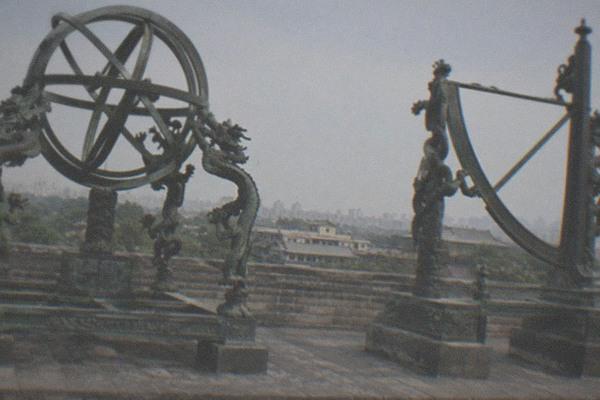
The terrace is the reason to come. Along the top of the platform stands a row of large bronze astronomical instruments, armillary spheres and related sighting devices, cast for imperial astronomy and left in place on their original working platform. You can walk the terrace, stand beside each instrument, and read the markings on the metal, which is rarer than it sounds: most Chinese museums display reproductions, while here the instruments sit where they were used.
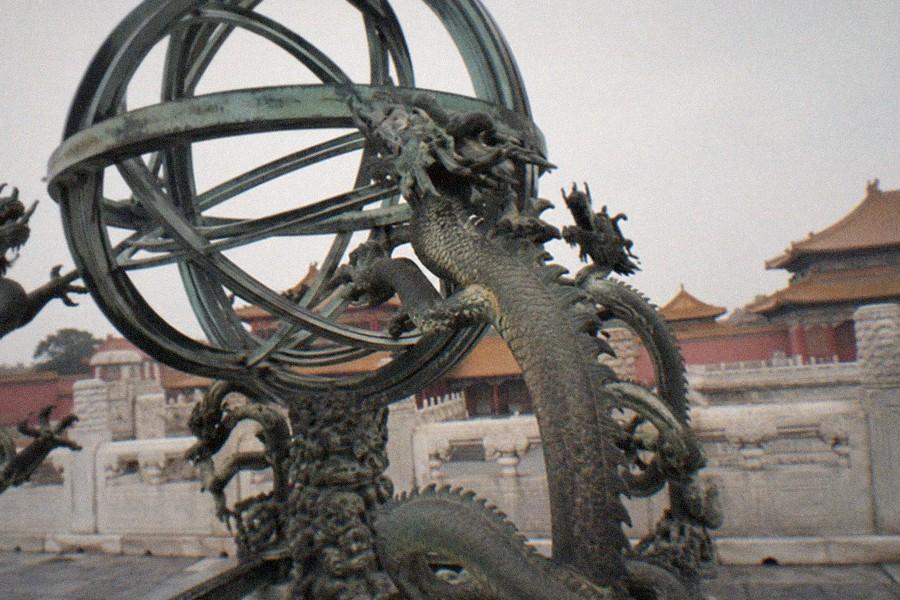
The instruments are the kind of object that photographs better the longer you look at them. Each is a framework of rings and sights, dense with graduated scales, mounted on ornate bronze stands. They were built to do serious work: fixing the positions of stars, measuring the sun's altitude, tracking the movements that determined the imperial calendar. The calendar was a matter of state. Getting it wrong was not an academic embarrassment but a political one, which is why the court funded precision instruments at this level.
The design lineage is genuinely international. Several of the instruments show European astronomical thinking merged with Chinese craftsmanship, a result of the Jesuit scientists who served at the Qing court and re-equipped the observatory. Standing on the terrace you can see that fusion in the metal itself: Chinese casting and ornamentation carrying geometry that traces back to European observatories. Few sites in Beijing make cultural exchange this tangible.
The terrace also gives you a view worth the climb. The platform rises above the surrounding neighborhood, and the contrast is sharp: bronze instruments centuries old, framed by the office towers of Jianguomen. Photographers tend to gravitate to the corner where an instrument's silhouette cuts against the modern skyline. Go in the morning if you want that shot, because the light comes from the east and the towers haze out by afternoon.
Practical notes for the terrace: it is an outdoor surface reached by stairs, so dress for the weather, and the instruments are fenced or roped where touching would damage them. Plan to spend the bulk of your visit up here. Read the plaques, walk the row twice, and give the armillary spheres the time they deserve. Visitors who rush the terrace to reach the halls have the experience backwards.
How Do You Get In? Price, Reservation, And The Tuesday Closure
Entry costs CNY 20 at the door, and a reservation is mandatory: the booking window opens 5 days ahead through the observatory's own channel, which it shares with the Beijing Planetarium. The site is closed on Tuesdays, except national holidays, and there is no third-party booking product for it at all, so the museum's own reservation system is the only route.
This is the part of the visit that needs the most planning, and it is where the site's Beijing Museums approach matters: know the window before you build your day around it. The reservation opens 5 days ahead. That is a shorter runway than the Palace Museum's 7 days but longer than the Confucius Temple's single day, and it means you should decide your observatory day well before you arrive in Beijing rather than hoping for a same-day slot.
The channel is the observatory's own, run through the Beijing Planetarium's public reservation system, which manages the observatory's visits alongside its own. The Planetarium's official pages describe the arrangement and the current booking procedure, and the reservation entrance itself is at the Planetarium's ticketing site, the ancient observatory booking page. Because the venue sells no third-party product, there is nothing to compare against: the CNY 20 door price and the official reservation are the whole transaction.
The Tuesday closure is the trap. Most of Beijing's national museums close on Monday, so travelers instinctively treat Monday as the dead day and shuffle everything else around it. The observatory closes Tuesday instead, the same day as the Planetarium it answers to. A visitor who spends Monday at the Capital Museum, which closes Tuesday, and Tuesday at the observatory, has the closures exactly backwards. Write the closed day into your plan before anything else.
| Detail | What to plan for |
|---|---|
| Door price | CNY 20 |
| Reservation | Mandatory |
| Booking window | Opens 5 days ahead |
| Channel | The museum's own system, shared with the Beijing Planetarium |
| Closed day | Tuesday, except national holidays |
| District | Dongcheng, near Jianguomen |
One more planning note: the observatory is compact, so it pairs naturally with a morning or afternoon elsewhere rather than standing as a full-day destination. Hold that thought for the pairing section below, because the geography works strongly in your favor.
The science museum is the one venue in this story that does have a bookable product, from $21, and it needs its own reservation 7 days ahead at 18:00. If your observatory day is a science day, that is the booking to line up first.
The Exhibition Halls And The Garden Below The Platform
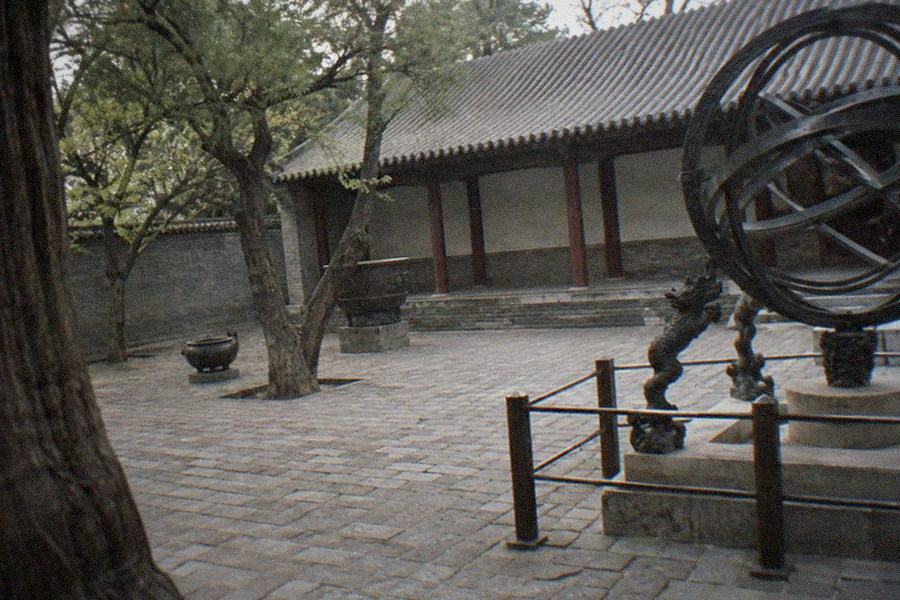
Below the terrace, the site holds small exhibition halls on the history of Chinese astronomy and a garden displaying historic timekeeping and measuring devices, including sundials and related stone instruments. The halls are modest in size and mostly in Chinese with some English labeling, so the garden and the terrace carry most of the experience for non-Chinese readers. Budget your time accordingly: the halls inform, the terrace impresses.
The halls tell the story the instruments imply: how the imperial astronomical bureau worked, what it measured, and why the state cared so deeply about the sky. Displays cover the development of Chinese astronomy, the instruments' functions, and the observatory's role in the calendar and timekeeping. If you read Chinese, the depth is considerable. If you do not, you will still follow the broad arc, but the garden will do more for you.
The garden is the quiet pleasure of the site. Stone sundials and measuring devices stand on the grounds around the platform, and they reward the same slow looking as the bronze instruments upstairs. Some pieces are working devices, some are display pieces, and the distinction is marked where it matters. On a weekday morning the garden can be nearly empty, which in a city of Beijing's tourist volume feels like a small luxury.
Visitors coming from the big state museums should calibrate expectations honestly. This is not the National Museum of China and does not try to be. The halls are rooms, not wings. What you get in exchange is intimacy: you can stand alone on a working imperial observatory platform, which no amount of gallery square footage reproduces. People who love instruments, craftsmanship, or the history of science rate the site highly. People seeking blockbuster exhibitions leave quickly.
For families, the garden and terrace are the draw. Children can grasp a sundial faster than a display case, and the site's size means no one gets museum fatigue. The Planetarium, which covers the same theme with shows and modern exhibits, is the natural complement; its show ticket and booking details are covered in the Planetarium show ticket guide, and since the two venues share a reservation system you can plan both in one sitting.
Is The Ancient Observatory Worth The Trip For A Short Beijing Visit?
For a first trip of three or four days, the observatory is a worthwhile add-on rather than a must-see: it costs little, takes an hour or two, and delivers something no other Beijing site does, but the Palace Museum, Temple of Heaven, and National Museum come first. For a second visit, a science-focused itinerary, or a traveler based near Jianguomen, it moves up the list considerably.
The honest ranking depends on what you travel for. If your Beijing list is imperial, the observatory still fits, because the instruments are imperial objects and the platform is an imperial institution. If your list is science, the observatory is essential, and the question is only what you pair it with. If your list is art, skip it without guilt and spend the afternoon at the National Art Museum of China instead, which is free with a reservation opening 7 days ahead at 16:00.
Time budget: count on an hour to ninety minutes at a comfortable pace, longer if you read the hall displays in Chinese. Add travel time and you have a half-morning or half-afternoon block. That makes it a natural companion to a larger science stop, and here the China Science and Technology Museum is the strongest pairing in the city: a four-floor modern museum whose main hall reservation opens 7 days ahead at 18:00, with a paid booking product from $21. Whether it suits adults as much as families is covered in the science museum for adults guide.
For travelers who want the booking handled in English, that product is the one bookable option among the observatory's whole family of venues, and the museum itself is a full day's counterpart to the observatory's compact hour.
Season matters less here than at outdoor parks, because the terrace is small and the halls are indoors, but the terrace is exposed: summer midday is hot on the brick, and winter wind on a raised platform is real. Spring and autumn are the sweet spots. Whenever you go, the Tuesday closure is the one hard constraint, and the 5-day reservation window is the one deadline.
Pairing The Observatory With Beijing's Other Science Stops
The observatory anchors a science day that can include the Beijing Planetarium, which shares its reservation system, the China Science and Technology Museum in Chaoyang, and, for a full-day outing, the Zhoukoudian Peking Man Site Museum out in Fangshan. The Planetarium is the closest match thematically and geographically, while Zhoukoudian is a day trip outside central Beijing that needs its own planning.
The Planetarium in Xicheng is the obvious companion. It shares the observatory's management, its reservation channel, and its Tuesday closure, and it covers the same subject with modern shows and exhibits. Its booking window opens 5 days ahead, and its shows are ticketed separately from the exhibition halls. Doing both venues in one science-themed day is a satisfying structure: ancient instruments in the morning, planetarium shows in the afternoon.
The science museum in Chaoyang widens the day into the modern era. Its main hall door price is CNY 30, its reservation opens 7 days ahead at 18:00, and its theaters and children's areas are ticketed separately by session. It is the biggest and most time-hungry of the three, so if you are combining it with the observatory, put the observatory first in the morning while the terrace is quiet.
Zhoukoudian is the outlier, and it is a commitment: a paleoanthropology site in Fangshan, outside central Beijing, where the Peking Man fossils were found. Entry is CNY 30 at the door, the reservation opens 7 days ahead at 17:00, and the site closes Monday except national holidays. It is not a same-morning add-on to anything. It is a day trip, and travelers who make it report a very different experience from the downtown museums: excavation sites, a site museum, and open ground rather than galleries. Whether it earns the long ride is weighed in the Zhoukoudian worth-it guide.
For that day trip, a booking product exists from $13, which handles the reservation under your passport details the way the downtown venues' products do.
| Science venue | District | Door price | Booking window | Closed day |
|---|---|---|---|---|
| Beijing Ancient Observatory | Dongcheng | CNY 20 | 5 days ahead | Tuesday, except national holidays |
| Beijing Planetarium | Xicheng | Show-dependent | 5 days ahead | Tuesday, except holidays |
| China Science and Technology Museum | Chaoyang | CNY 30 | 7 days ahead at 18:00 | Monday, except statutory holidays |
| Zhoukoudian Peking Man Site Museum | Fangshan | CNY 30 | 7 days ahead at 17:00 | Monday, except national holidays |
Planning Your Visit: Timing, Access, And The One Mistake To Avoid
Plan the observatory as a 60 to 90 minute stop on a science-themed half day: reserve 5 days out through the Planetarium's channel, avoid Tuesday, pay CNY 20 at the door, and pair it with the Planetarium or the science museum nearby. The one mistake to avoid is assuming free or walk-in access, because this venue requires a reservation even at its modest scale, and the window is only five days.
Access is straightforward. The site is in Dongcheng near Jianguomen, on the Second Ring Road's east side, and the surrounding streets are flat and walkable. Subway and taxi access in this corridor are among the best in the city, so the observatory slots easily into a Dongcheng day that might otherwise include the Lama Temple to the north or the National Museum to the west. The nearest stations and exits are stable street-level facts you can confirm on any map app on arrival.
Timing within the day: mornings are quieter, the light on the terrace is better, and the site's small capacity means a modest tour group can fill the terrace fast. Late afternoon works too, but the halls begin winding down before the park-style venues do, so confirm last entry when you reserve rather than assuming the door price covers all day.
The mistake worth repeating, because it is the expensive one: treating the closed day as interchangeable across Beijing. The observatory closes Tuesday. The Capital Museum also closes Tuesday. The Palace Museum, the National Museum of China, the science museum, and the Natural History Museum close Monday. Build your week around the two closure families and everything else falls into place. A fuller walk-through of which venues shut which day is in the museums open on Monday guide.
One last note on the booking itself. Because no third-party product exists for this venue, any listing claiming to sell observatory entry is not what it appears, and the museum's own channel is the only legitimate route. That is not a loss. The reservation is cheap, the site is uncrowded, and the terrace of bronze instruments under the Jianguomen skyline is one of Beijing's most quietly rewarding hours.
Common Questions About The Beijing Ancient Observatory
What Can You Actually See At The Beijing Ancient Observatory?
A rooftop terrace of antique bronze astronomical instruments, a garden with stone sundials and measuring devices, and small exhibition halls on the history of Chinese astronomy. Entry is CNY 20, reservation is mandatory with a window opening 5 days ahead, and the site closes Tuesday except national holidays.
Do you need a reservation for the Beijing Ancient Observatory?
Yes. A reservation is mandatory, and the booking window opens 5 days ahead through the venue's own channel, which it shares with the Beijing Planetarium. There is no third-party booking product for this venue.
What day is the Beijing Ancient Observatory closed?
Tuesday, except national holidays. This differs from most major Beijing museums, which close Monday, so check the closed day for every venue on your itinerary rather than assuming Monday across the board.
How much does the Beijing Ancient Observatory cost?
CNY 20 at the door. That is the venue's own admission price; there is no separate third-party ticket product, so the official reservation plus the door price is the entire transaction.
How long does a visit to the Beijing Ancient Observatory take?
Plan on 60 to 90 minutes at a comfortable pace: the terrace takes the bulk of the time, the garden a little more, and the halls depend on whether you read the displays in Chinese. It pairs well with a half-day science itinerary.
Is the Beijing Ancient Observatory worth visiting?
For travelers interested in the history of science, instruments, or imperial astronomy, yes, strongly: it is intimate, uncrowded, and physically authentic. For a first visit focused on headline sights, treat it as an add-on rather than a priority.